
Benidorm, 30 September 2026.
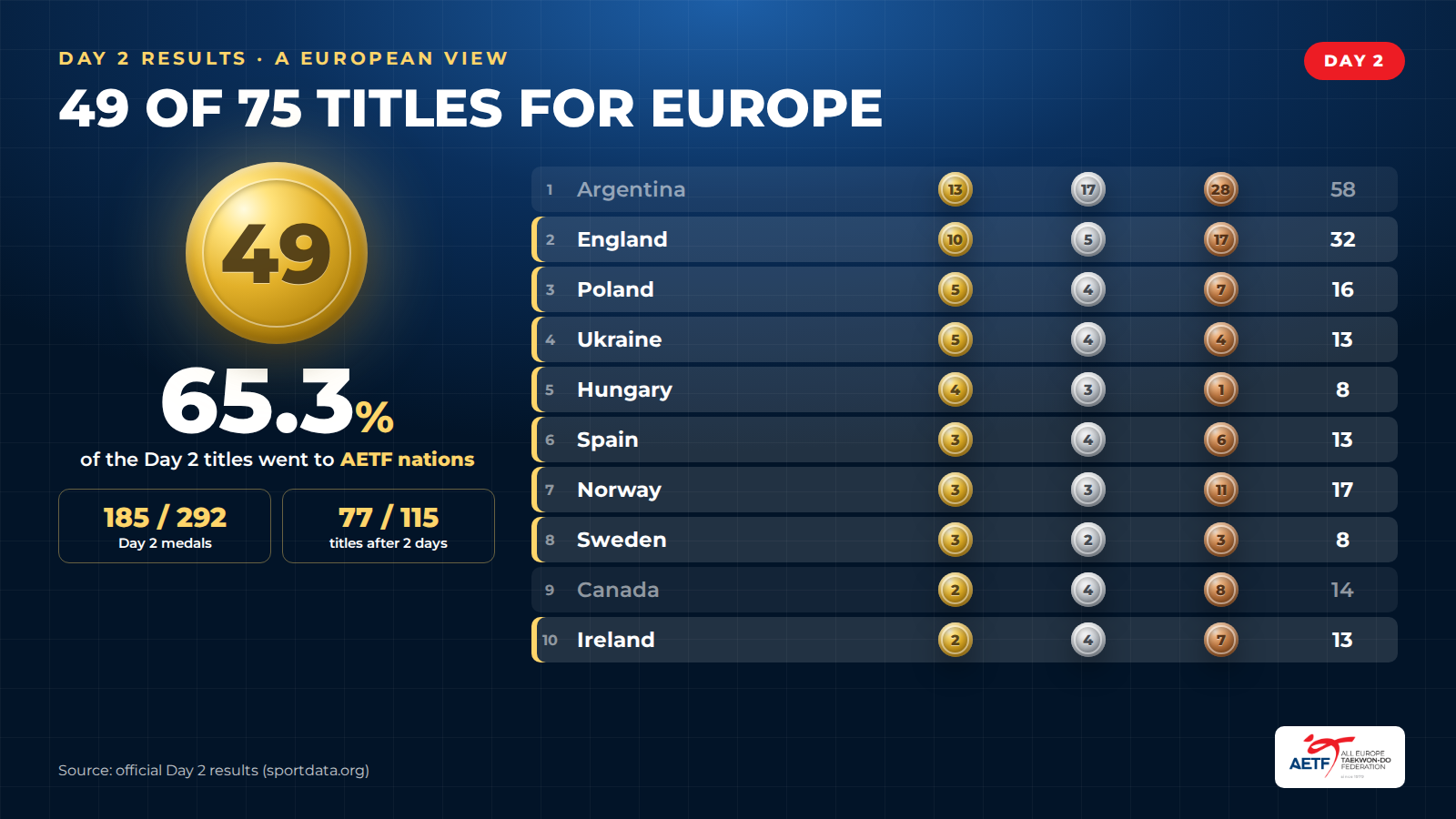
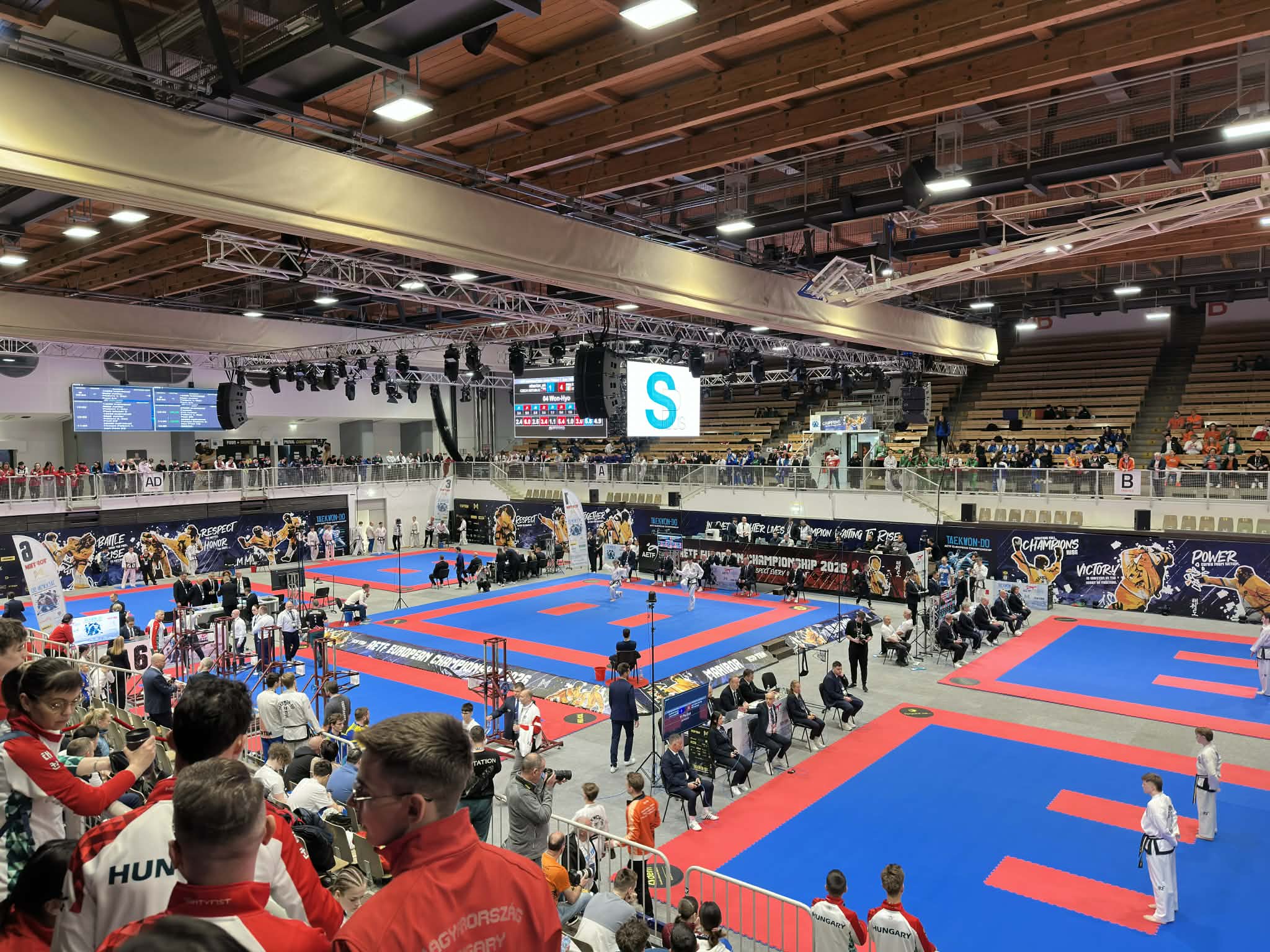
The second day of the 10th ITF Taekwon-Do World Cup belonged to experience. With the Masters and Veterans on the mats across all eleven rings, 75 more World Cup titles were decided, and 49 of them went to AETF nations (65.3%). European athletes also won 185 of the 292 medals awarded on the day.
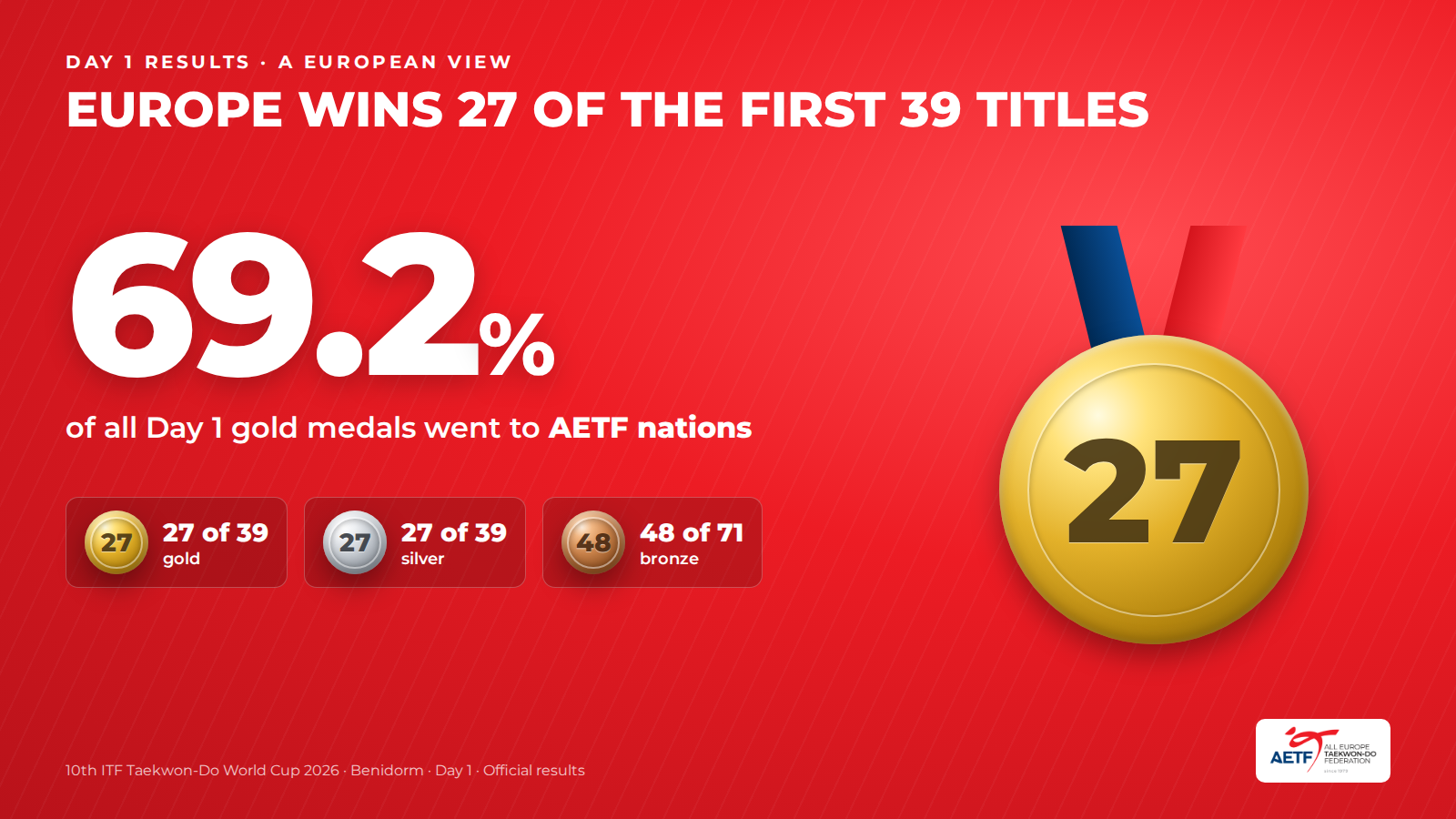
After two days of competition, Europe has won 77 of the 115 titles (67.0%).
The heart of the World Cup
At 15:00 on Wednesday, the pace in Rings 4 and 5 changed. For one afternoon these two rings belonged to the athletes of the 3rd ITF Adapted Taekwon-Do World Cup, and for many in the arena it became the most moving part of the week.
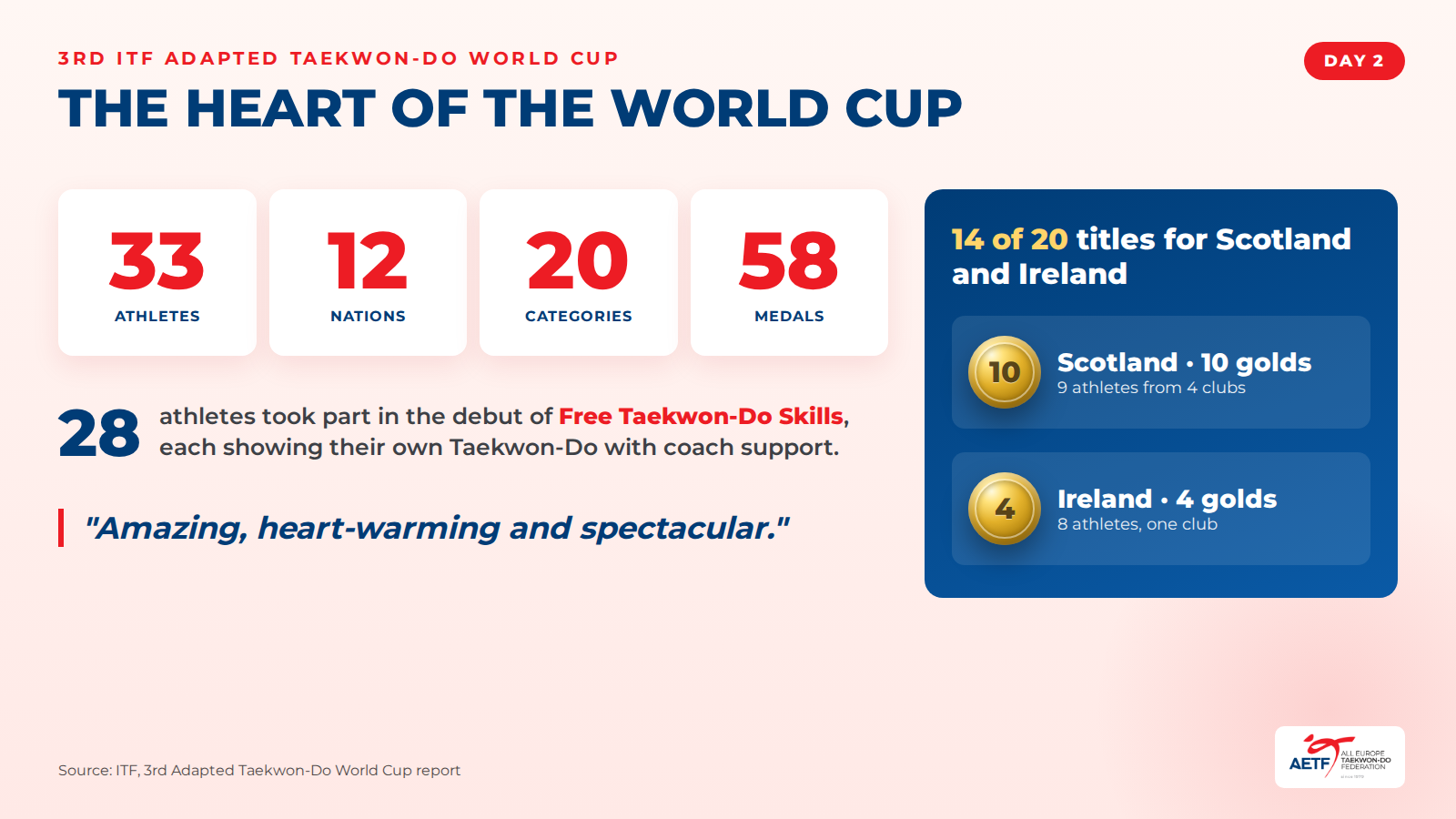
33 athletes from 12 nations and 20 clubs stepped onto the mats:
- athletes who are blind;
- athletes with autism;
- athletes with physical disabilities;
- athletes who compete from a wheelchair.
Each of them came to show what Taekwon-Do means to them. Across 20 categories they made 61 entries, and 58 medals were awarded. It was the biggest Adapted World Cup so far, a clear sign of how much this part of our sport has grown since its first edition.
The athletes competed in two formats:
- Tul (patterns): athletes delivered technical performances of real precision and control.
- Free Taekwon-Do Skills: this new format made its debut, and it was where the afternoon truly came alive. 28 athletes chose their own way to show their Taekwon-Do: a pre-arranged sequence, a free combination of techniques, or powerful work on the punch pads, with coaches and helpers at their side.
Many coaches were visibly moved as their athletes performed. The ITF President and a delegate of VIRTUS, the world federation for athletes with intellectual impairments, followed the competition closely throughout the afternoon. Those who were there described the atmosphere as “amazing, heart-warming and spectacular.”
Two AETF nations played a big part in the story:
- Scotland came with 9 athletes from 4 clubs, made 18 entries and won 10 golds.
- Ireland brought 8 athletes from a single club, made 16 entries and won 4 golds.
Together they won 14 of the 20 titles. Behind those numbers are clubs and coaches across Europe who open their doors to every athlete, week after week.
Beyond the medals, the Adapted World Cup was a reminder of what “Taekwon-Do for All” really means: a place on the mat, and a moment in the spotlight, for everyone.
The clubs behind Team Europe
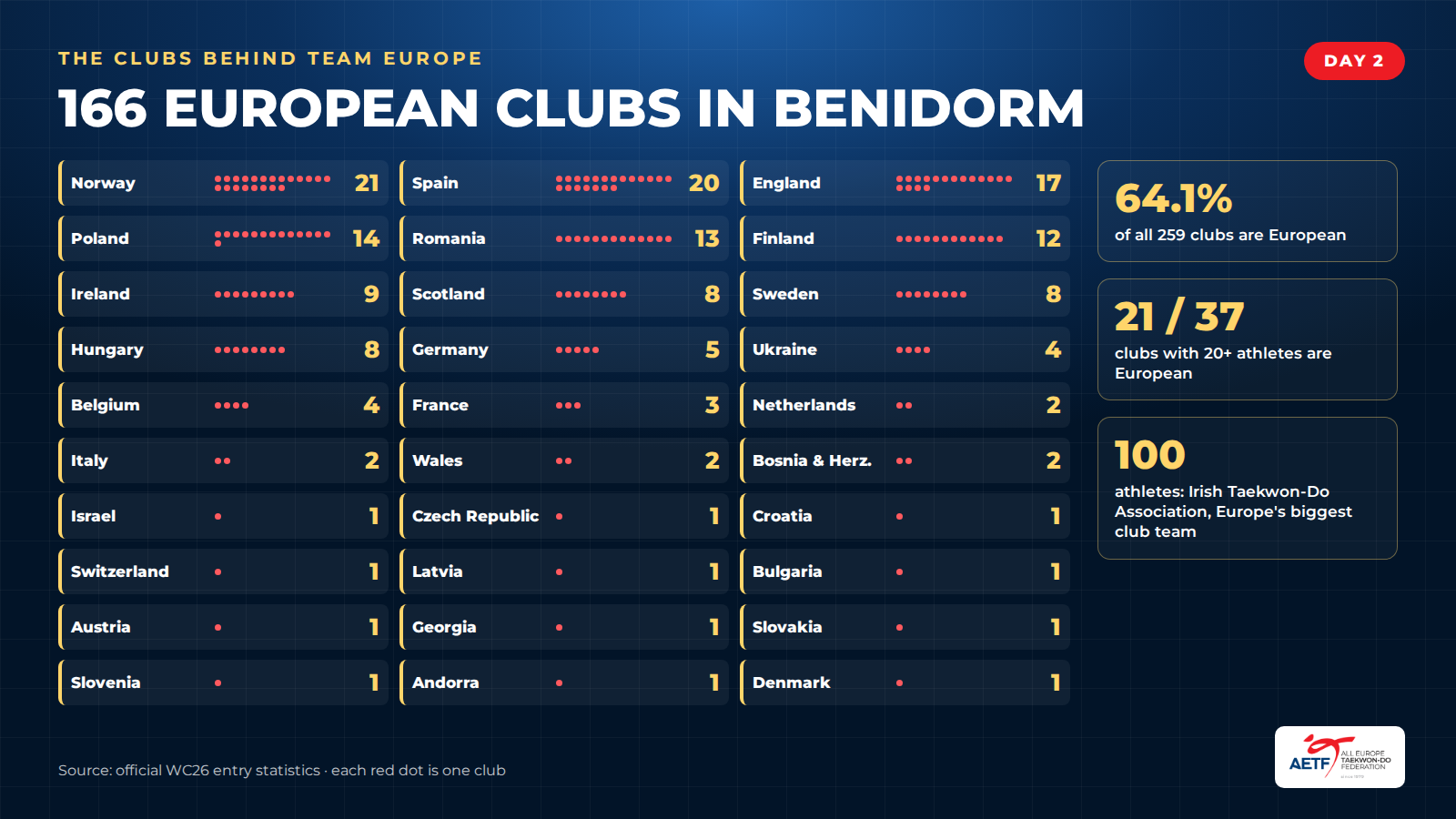
166 of the 259 clubs in Benidorm (64.1%) come from AETF nations, and 21 of the 37 clubs that brought 20 or more athletes are European. Europe’s biggest club teams:
- the Irish Taekwon-Do Association (100 athletes);
- the Polish Taekwon-Do Association (82);
- ITF Netherlands (59).
Clubs per nation:
| Nation | Clubs | Athletes |
| Norway | 21 | 170 |
| Spain | 20 | 194 |
| England | 17 | 159 |
| Poland | 14 | 154 |
| Romania | 13 | 66 |
| Finland | 12 | 87 |
| Ireland | 9 | 261 |
| Scotland | 8 | 65 |
| Sweden | 8 | 65 |
| Hungary | 8 | 29 |
| Germany | 5 | 70 |
| Ukraine | 4 | 134 |
| Belgium | 4 | 27 |
| France | 3 | 12 |
| Netherlands | 2 | 67 |
| Italy | 2 | 38 |
| Wales | 2 | 14 |
| Bosnia and Herzegovina | 2 | 4 |
| Israel, Czech Republic, Croatia, Switzerland, Latvia, Bulgaria, Austria, Georgia, Slovakia, Slovenia, Andorra, Denmark | 1 each | 2–29 |
| Team Europe | 166 | 1,751 |
Norway brings the most clubs, while Ireland’s 261 athletes come from just 9 clubs, the most concentrated team in Europe.
An Olympic-sized World Cup
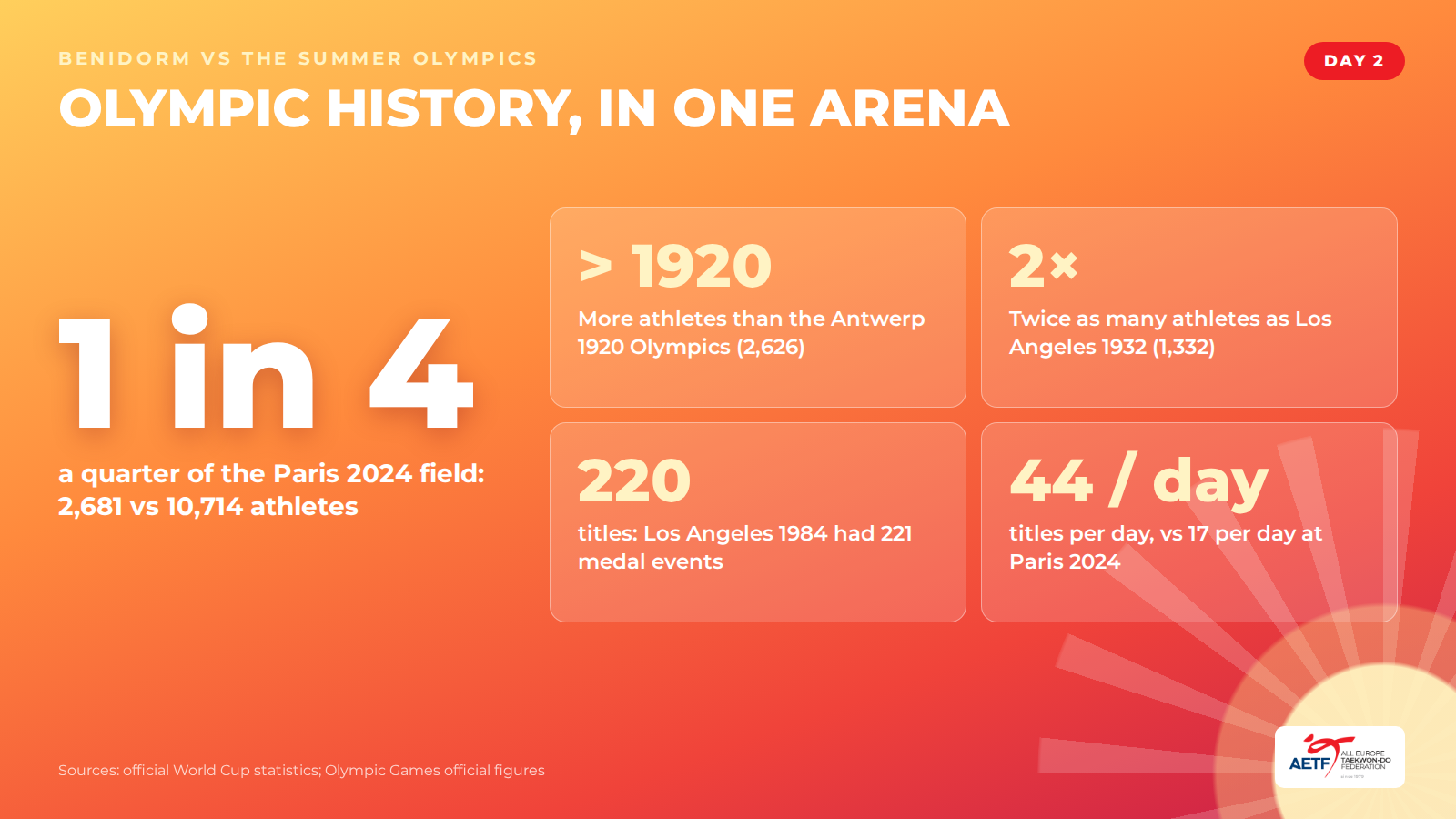
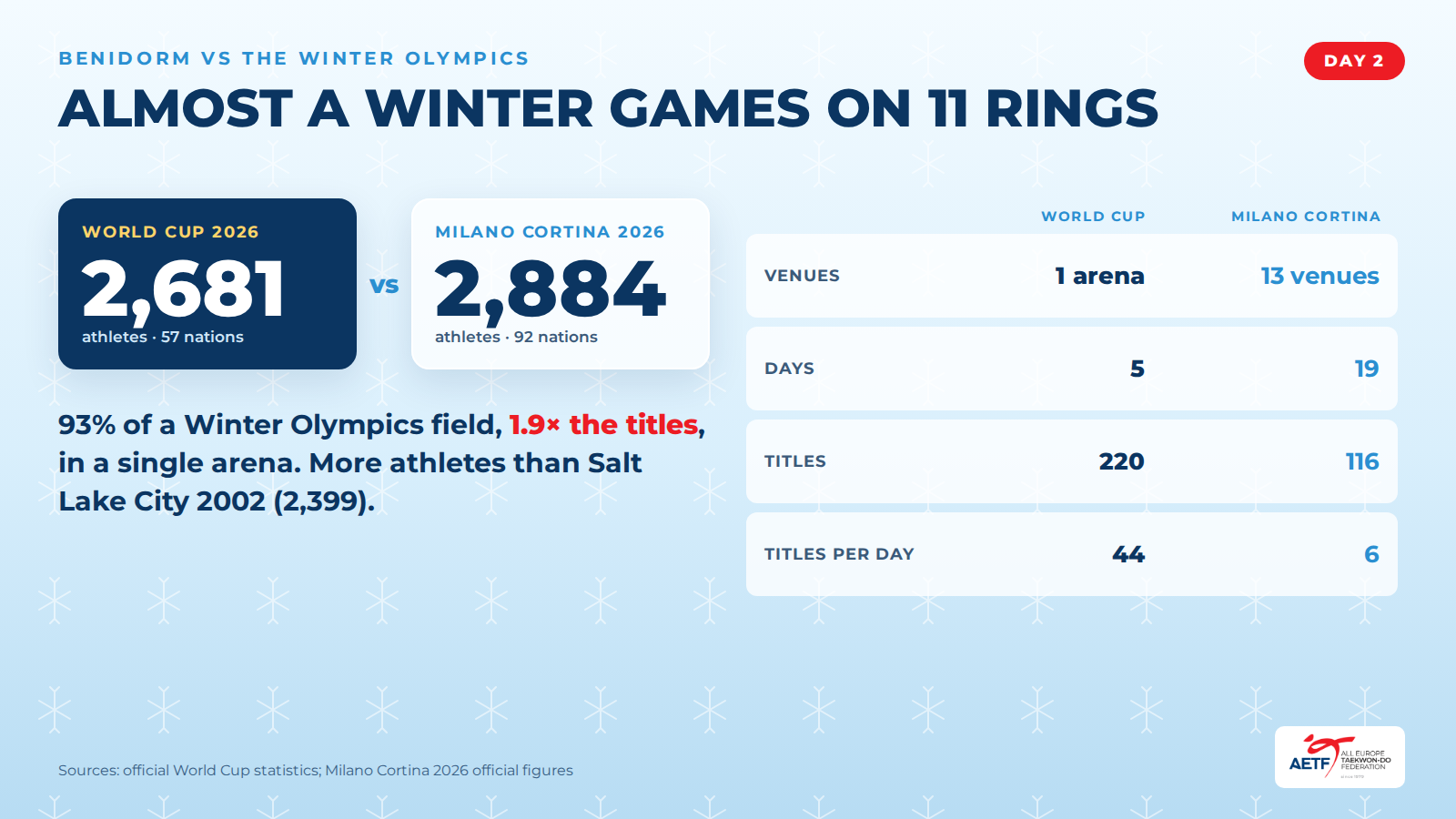
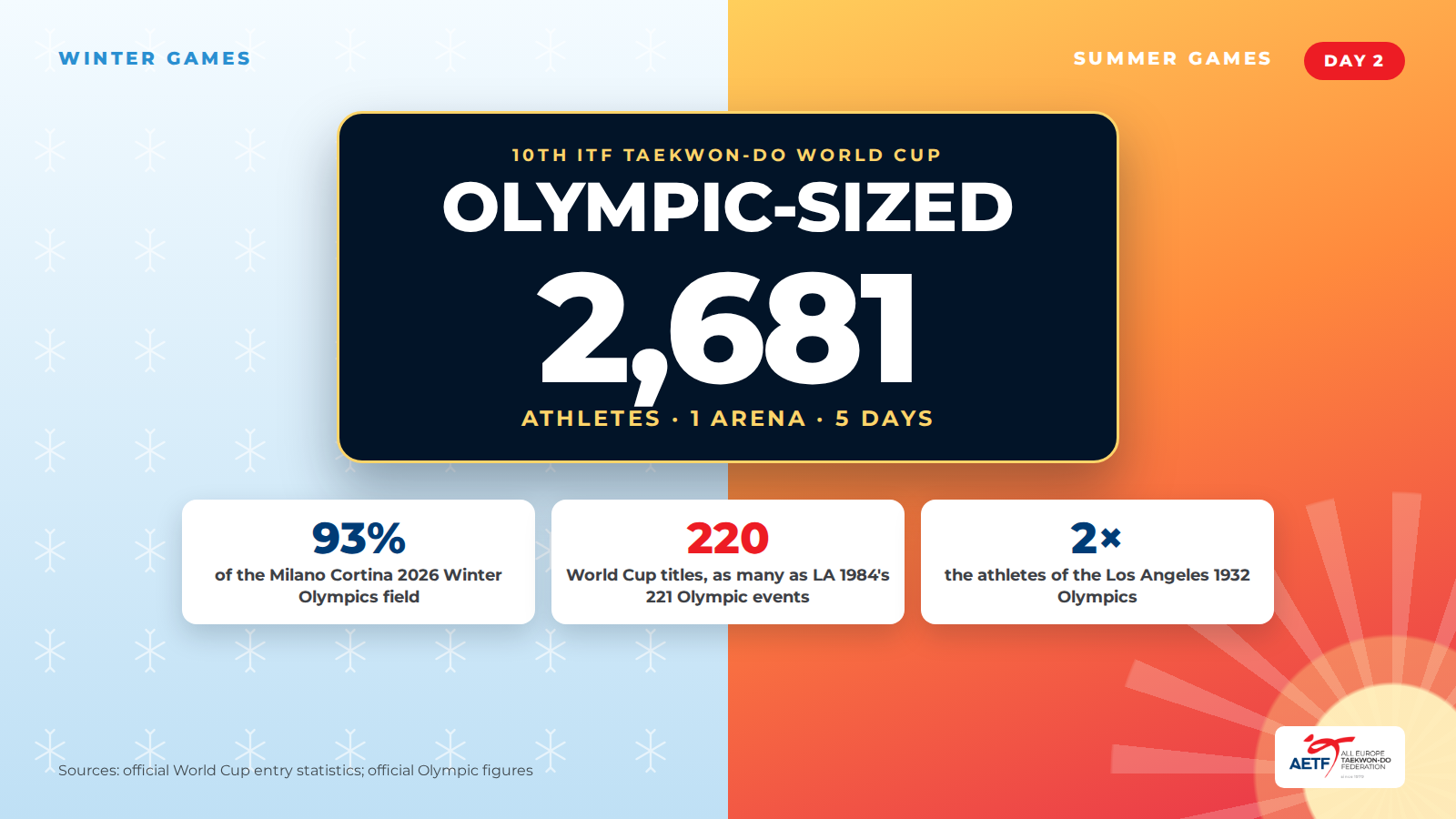
How big is this World Cup? With 2,681 athletes, Benidorm hosts:
- 93% as many athletes as the Milano Cortina 2026 Winter Olympics (2,884), and more than Salt Lake City 2002 (2,399);
- more athletes than the Antwerp 1920 Olympics (2,626), and twice as many as Los Angeles 1932 (1,332);
- a quarter of the Paris 2024 field (10,714).
The 220 World Cup categories almost match the 221 medal events of the Los Angeles 1984 Olympics, and are close to twice the 116 events of Milano Cortina 2026.
What makes Benidorm unique is how it all runs:
| World Cup 2026 | Milano Cortina 2026 | Paris 2024 | |
| Venues | 1 arena, 11 rings | 13 venues | Paris region, other host cities and Tahiti |
| Days | 5 | 19 | 19 |
| Titles | 220 | 116 | 329 |
| Titles per day | 44 | 6 | 17 |
The Olympic Games run on very different budgets: the Paris 2024 organising committee closed with a budget of €4.48 billion, and the Milano Cortina 2026 organisers reported a budget of around €1.7 billion. The World Cup delivers an Olympic-sized field in a single arena, run by national associations, clubs and volunteers.
Tomorrow: Day 3 starts at 09:00 with the senior pattern finals in Ring 1. At 18:30, all women of the World Cup are invited to the “Be YOU. Bravely” group photo in the arena.
Europe’s Day 2 World Cup champions
By nation, in order of gold medals won. Names as in the official results list, surname first.
England (10)
- Hassan-Spiller Mirfet: Female 46+, Pattern, 4th–6th Dan
- Wright Bethany: Female 36–45, Special Technique, 4th–1st Gup
- Clamp Kerry: Female 46+, Pattern, 2nd–1st Gup
- Wolowiec-Mozgiel Joanna: Female 36–45, Pattern, 2nd Dan
- Dihal Kanta: Female 18–35, Sparring, 4th–1st Gup, 55–60 kg
- Billones Lewis: Male 15–17, Sparring, 4th–1st Gup, up to 50 kg
- Whittaker Paige: Female 15–17, Sparring, 4th–1st Gup, 57–61 kg
- Swatek Ewelina: Female 36–45, Sparring, 1st–6th Dan, 69–75 kg
- Hodgetts Sebastian: Male 15–17, Sparring, 4th–1st Gup, 65–70 kg
- Ralph Orla: Female 18–35, Sparring, 4th–1st Gup, 60–70 kg
Poland (5)
- Jamuła Paulina: Female 18–35, Sparring, 4th–1st Gup, 50–55 kg
- Sobucka Martyna: Female 15–17, Sparring, 4th–1st Gup, 45–49 kg
- Rosiński Rafał: Male 46+, Pattern, 2nd–1st Gup
- Tomczyk Krystian: Male 36–45, Pattern, 2nd–1st Gup
- Żłobicki Jakub: Male 15–17, Sparring, 4th–1st Gup, over 75 kg
Ukraine (5)
- Vovk Ivan: Male 15–17, Special Technique, 1st–3rd Dan
- Yurasov Roman: Male 12–14, Sparring, 4th–1st Gup, 55–60 kg
- Rudiak Oleksandr: Male 15–17, Sparring, 4th–1st Gup, 55–60 kg
- Tarasova Oleksandra: Female 15–17, Sparring, 4th–1st Gup, 53–57 kg
- Harbera Vlas: Male 15–17, Sparring, 4th–1st Gup, 50–55 kg
Hungary (4)
- Vass Izabella: Female 46+, Pattern, 4th–3rd Gup
- Hajma Miklós: Male 46+, Pattern, 4th–3rd Gup
- Lakatos Marco: Male 46+, Pattern, 2nd Dan
- Darnai János: Male 36–45, Pattern, 2nd Dan
Norway (3)
- Stendal Tom Olav: Male 46+, Pattern, 3rd Dan
- Forgaard Bjarte: Male 46+, Pattern, 1st Dan
- Da Silva Daniela Gomes: Female 46+, Pattern, 1st Dan
Spain (3)
- Vidal Toca Daniel: Male 12–14, Sparring, 4th–1st Gup, 50–55 kg
- López Palacios Noa: Female 15–17, Sparring, 4th–1st Gup, 49–53 kg
- Gimenez Romera Emma: Female 15–17, Sparring, 4th–1st Gup, up to 45 kg
Sweden (3)
- Davidson Lee Ti: Female 46+, Special Technique, 1st–6th Dan
- Hultbäck Charlie: Male 12–14, Sparring, 4th–1st Gup, 45–50 kg
- Hovelius Maria: Female 36–45, Sparring, 1st–6th Dan, over 75 kg
Germany (2)
- BenCheikh Nour: Female 18–35, Sparring, 4th–1st Gup, up to 50 kg
- Makhmudov Akhmad: Male 15–17, Sparring, 4th–1st Gup, 60–65 kg
Ireland (2)
- Franks Christine: Female 18–35, Sparring, 1st–6th Dan, 55–60 kg
- Roche Nick: Male 46+, Sparring, 1st–6th Dan, over 84 kg
Italy (2)
- Farigu Silvia: Female 36–45, Pattern, 4th–6th Dan
- Sinis Delia: Female 46+, Pattern, 2nd Dan
Netherlands (2)
- van Kasteren Lana: Female 18–35, Sparring, 4th–1st Gup, over 70 kg
- van der Wal Tirsa: Female 15–17, Sparring, 4th–1st Gup, 61–65 kg
Slovenia (2)
- Barada Tyra: Female 18–35, Sparring, 1st–6th Dan, up to 50 kg
- Baloh Tina: Female 18–35, Sparring, 1st–6th Dan, 65–70 kg
Belgium (1)
- Ciobanu Adelina-Larisa: Female 36–45, Pattern, 4th–3rd Gup
Finland (1)
- Kivioja Kalle: Male 18–35, Power Breaking, 1st–6th Dan
France (1)
- Mouret Laura: Female 36–45, Sparring, 1st–6th Dan, 63–69 kg
Romania (1)
- Cocoara Andrei Mihai: Male 36–45, Pattern, 1st Dan
Scotland (1)
- Waddell Hollie: Female 18–35, Sparring, 1st–6th Dan, 60–65 kg
Wales (1)
- Davies Kelsey: Female 15–17, Sparring, 4th–1st Gup, over 65 kg
Congratulations to all 49 of Europe’s Day 2 World Cup champions!
Source: official results (sportdata.org), the ITF report on the 3rd Adapted World Cup, and official Olympic figures. “Europe” refers to the AETF member nations. Olympic comparisons use athletes and medal events; World Cup categories are narrower, by age, grade and weight.